
In the last tutorial I was introduced to granular synthesis, which has transformed the potential sounds of this project. I’d heard of granular synthesis before but had never used it. I’ve been exploring granular synthesis through Ableton’s Max for Live Granulator. It’s completely expanded my sonic possibilities. The granulator works by altering small samples, known as grains. This is an explanation;
“It is based on the same principle as sampling. However, the samples are not played back conventionally, but are instead split into small pieces of around 1 to 50 ms. These small pieces are called grains. Multiple grains may be layered on top of each other, and may play at different speeds, phases, volume, and frequency, among other parameters.”
My approach has been to sample a small part of the original track and place it into the Granulator. I then experiment by playing on a midi and shifting the sample size. I record the entire experimentation process so I can resample the parts that interest me. I found that leaving the granulator to play out for long periods of time often produces interesting results. The granulator has been particularly useful for creating textual sounds needed for chords and melodies.
Here are two examples of my original granulator experimentation.
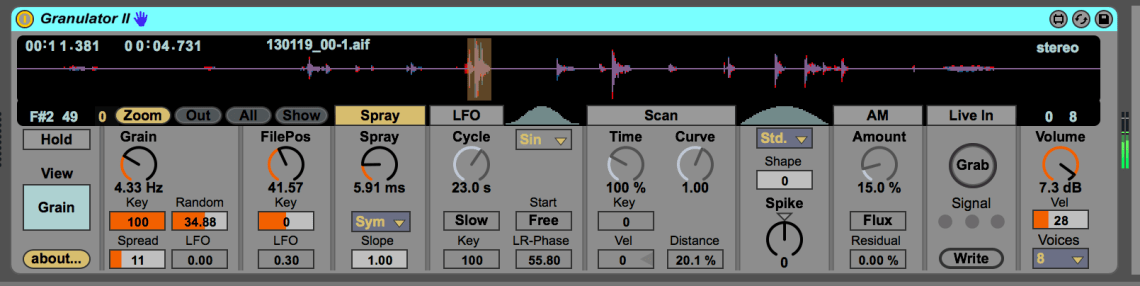
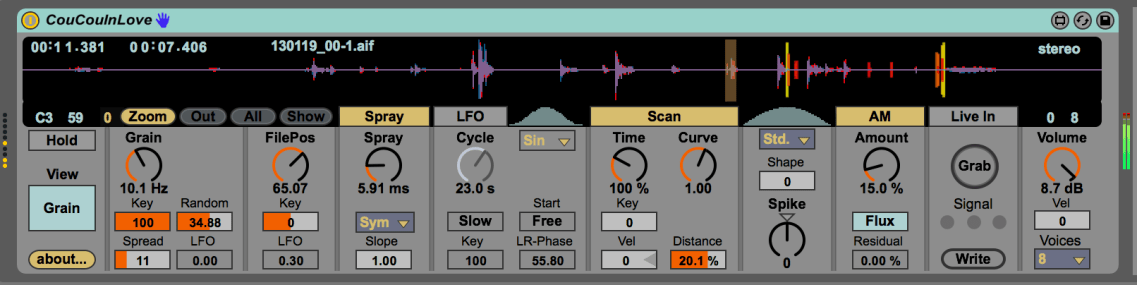
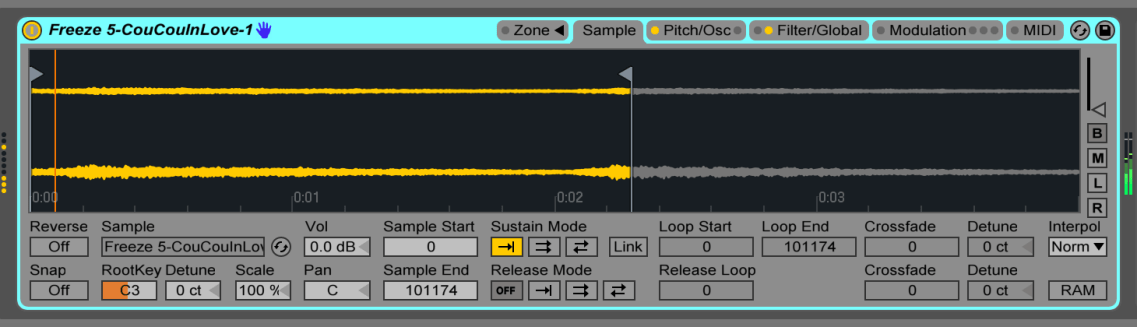
These are the chord sounds I was then able to create by resampling small, textual parts from the granulator into the Ableton sampler.

 Aesthetics Process